
The Ultimate Guide for Mastering Your CNA Certification Exam
Starting a career in healthcare as a CNA takes commitment, since the role requires accuracy in care along with genuine concern for people.. Before you can step onto the floor as a professional, you have to face the cna certification exam.
The exam makes sure that the candidates can safely care for patients in real-world settings. It does require careful preparation and a clear understanding of how the exam works
Data suggests that nearly one out of every four candidates will need a second attempt at one of the exam portions, however, by understanding the process of the test and the logic behind the grading, you can ensure you are in the group that passes on day one.
The Dual Nature of the CNA Exam Format
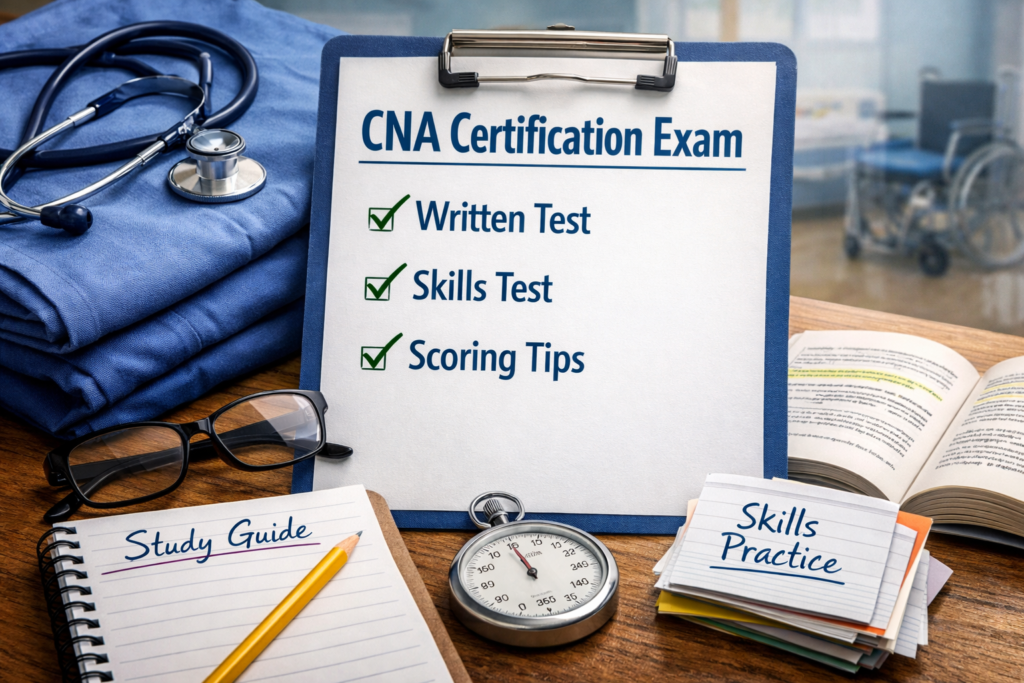
The first thing to understand about the nurse aide exam format is that it is divided into two i.e a Written Exam and a Skills Test. The core exam structure is always consistent across the United States, even though the requirements might vary for each state.
CNA Written Exam
The written exam has around 60-70 multiple-choice questions to answer with a time limit of a minimum of 90 minutes upto 2 hours. The content is are generally about patient rights, safety protocols, and basic nursing principles.
Many folks find the written exam challenging because they treat it like a memorization test where you just need to remember dates and names. In reality, this is a safety exam. When you look at a question, don’t just ask “What is the medical answer?” Ask yourself, “Which of these answers keeps the patient the safest and honors their rights?”
For example, if a question asks about the first thing you should do when entering a room, the common sense answer might be to start the task. However, the exam answer is always to identify the patient and pull the privacy curtain.
Note: There is also an option for Oral test for this part, specifically for people who have difficulty in reading.
CNA Skills Test
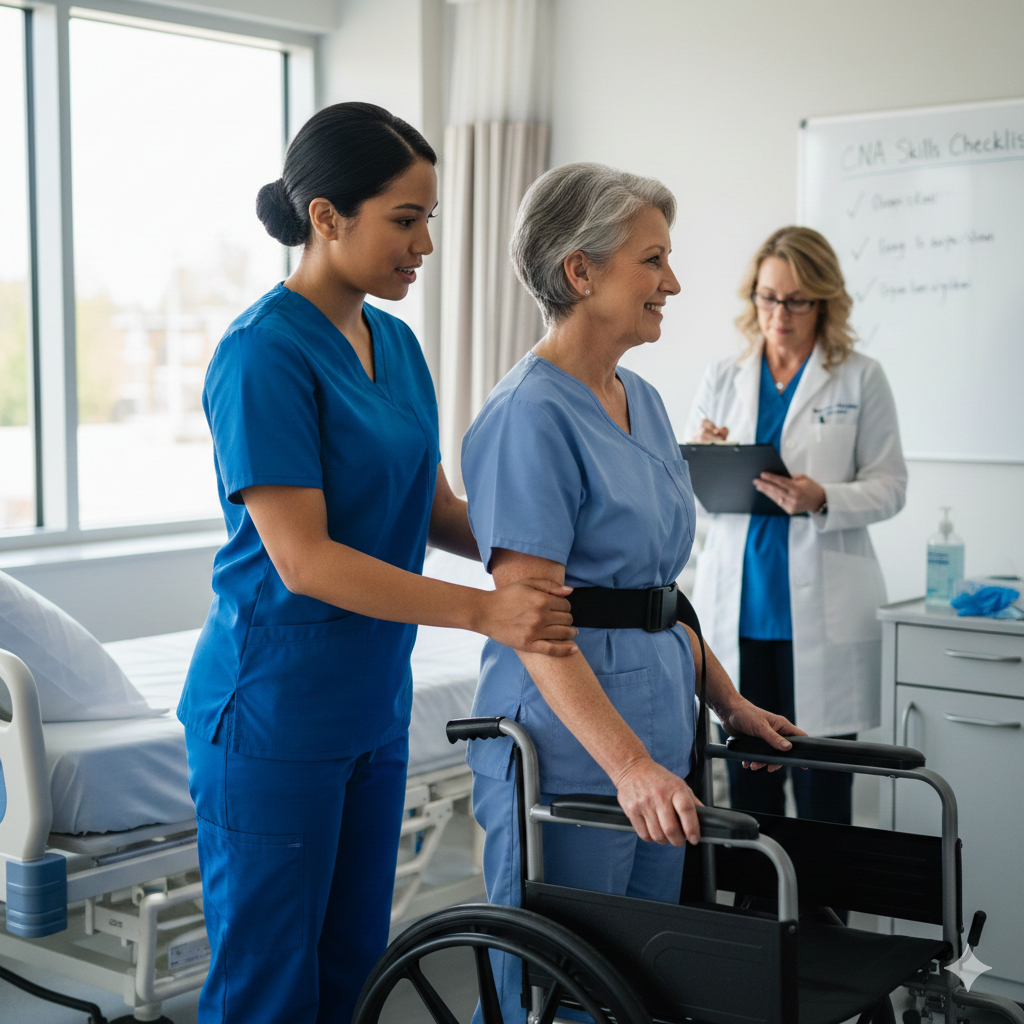
It is the second part of the nursing assistant exam, and here, you enter a simulated lab environment. An evaluator, usually a Registered Nurse asks you to perform a handful of tasks on a client (who is usually a fellow student). This is where the expertise element of your training shines.
Also, this is where the most heartbreaks occur. because even if you perform 95% of the task perfectly, missing one critical step may result in failure.
Essential Skills to Expect
Because all the patient care skills can’t be tested at once, therefore, most testing providers prioritize a few high priority ones that are closely tied to patient safety as given below:
• Proper hand hygiene, following the correct technique and timing.
• Applying knee-high slastic stockings: This is one of the basic CNA skills to enhance circulation.
• Indirect care: Things like patient privacy is respected and the placement of emergency call light so it is always within the patient’s reach.
• Locking both the bed and wheelchair brakes is a required safety step and must always be done to avoid failure.
What is on the CNA Exam: Topic Breakdown
To study effectively, you need to know how the exam is weighted because Cna test is never split evenly across various healthcare topics`. According to the standards set by the National Nurse Aide Assessment Program (NNAAP), the written portion is split into following categories:
Physical Care Skills (60-65%)
This is the largest portion of the exam and includes:
• Measuring Vitals with accuracy.
• Noticing a change in a patient’s condition.
• Restorative skills that help patients become independent again.
• Use of bedpan, catheter care, and patient trasferring mechanics.
• Activities of Daily Life such as bathing, grooming, feeding, toileting support, etc.
Psychosocial Care Skills (10-15%)
It includes the following:
• Emotional and mental health support.
• Cultural and Spiritual requirements.
Role of the Nurse Aide (15-20%)
This part of the exam is all about legal and ethical responsibilities of the role including HIPAA, abuse reporting, and understanding the professional boundaries.
Scoring and Assessment
In most U.S. states, the minimum passing score for the written CNA exam is around 70-75%, however, this percentage is not usually shown to the candidates, results are directly reported as pass or fail.
The exact cutoff depends on the your state and the testing provider (Prometric, Pearson, Headmaster, etc.)
On the other hand, the skills test does not use percentages at all, it solely tells whether it’s a pass or fail,
Reasons for Failing the CNA Exam on the First Attempt
Data shows that around 20-30% of folks fail at least one of the two Cna tests on their first attempt, and this is usually due to testing conditions or pressure rather than lack of knowledge.
Common reasons include:
- Rushing through skill steps might make you forget certain safety actions, therefore, it is generally recommended to narrate your actions which takes the evaluator into confidence and also calms down your brain.
- Poor time management
Most candidates easily pass the exam once they understand what examiners are looking for in the second attempt.
Flip Side: The Stress and the Cost
The cna certification exam process isn’t perfect because performing skills test under pressure does not always reflect how a person will perform in a real-world setting. Some of the best CNAs in the industry struggled with the testing environment because they were nervous too.
The fee of the exam can range from $100-$200 depending on your state and testing agency, however, retaking a failed section usually costs less than retaking the full exam.
Most states give you three attempts before requiring you to retake your training in case you fail the exam in the first attempt. If you fail the skills but pass the written, you usually only have to retake the skills portion (and vice versa).
Final Preparation Strategy
In the final week before your Cna test, focus on refining what you already know rather than learning new things. Practice your skills on a friend or even a large stuffed animal. Build your muscle memory by physically going through the actions of privacy, bedside table handling, handwashing, etc. to avoid any brain freeze moment.
Understanding the exam format properly, and regular practice definitely helps in performing better. It helps you stay calm during the test.
Below are some routines to follow for improving your chances of passing the exam:
- Follow the state’s candidate handbook: Every State has a specific handbook, read yours cover to cover. It is one of the keys to passing the exam.
- Simulate the pressure: To mirror the actual exam environment, select 3 random skills and complete them within a set time frame to build speed and composure.
- Say it out loud: Do not just read your handbook’s critical steps, speak them out loud until they lock into your memory
- There are various online resources to take practice tests. Utilize them to practice multiple times.
Frequently Asked Questions
How long does it take to get my cna certification exam results?
Computer-based written exam results are out right after the exam finishes, and the skills portion results are usually posted within 24 to 48 hours.
What happens if the patient in my skills test makes a mistake?
The person acting as the patient is instructed to be a neutral participant, therefore, you are only graded on your actions. If the patient accidentally helps, the evaluator may ignore it or ask the candidate to repeat the step.
Do I need to memorize specific medical dosages for the cna written exam?
No. CNAs do not administer medication, so you won’t be tested on dosages. However, you will be tested on how to recognize the side effects of medications and how to properly report them to the nurse on duty.